When people think about building strength, they often picture dumbbells, barbells, weight machines, or a traditional gym.
But resistance does not only come from heavy weights.
It can also come from water.
Every time you push, pull, kick, sweep, or change direction in the pool, your body has to move against the resistance of the water.
That is one of the reasons aqua fitness can feel surprisingly challenging.
A movement that appears simple from the pool deck can feel completely different when you are the one performing it underwater.
Mayo Clinic describes aquatic exercise as a low-impact activity and explains that water provides natural resistance that can help strengthen muscles.
The key is understanding how to use that resistance intentionally.
Because aqua fitness is not simply about moving around in the pool.
It is about learning how to use the properties of water to create a purposeful workout.
Related Reads:
How Aquatic Exercises Boost Blood Circulation Naturally
What Is Water Resistance Training?
Water resistance training is exercise that uses the natural resistance of water to challenge movement.
Think about the difference between moving your hand through the air and pushing that same hand quickly through the water.
The movement may be similar.
The resistance is not.
Water pushes back against your movement, which means the muscles have to work to move the arms, legs, and body through it.
Harvard Health explains that because water naturally provides resistance, many pool movements can challenge both the cardiovascular system and the muscles.
That is what makes the pool such a unique training environment.
Aqua fitness can include movements that look familiar from land exercise, such as:
- Squats
- Lunges
- Knee lifts
- Jumping jacks
- Arm curls
- Chest fly movements
- Presses
- Kicks
- Core rotations
But performing them in water changes the experience.
The water becomes part of the resistance.
Related Reads:
The Science Behind Water Resistance Training: Why It Works
Water Resistance Works Around the Body
One of the most interesting things about exercising in the water is that resistance is not limited to one specific piece of equipment.
You interact with resistance as you move through the water in different directions.
Push your arms forward. The water resists the movement.
Pull them backward. The water resists again.
Move to the side.
Change direction.
Sweep your arms downward.
Lift your leg forward or to the side.
Each movement requires your body to work against the surrounding water.
This makes aqua fitness especially useful for creating multidirectional movement patterns.
You are not limited to simply lifting something up and lowering it back down.
You can:
- Push
- Pull
- Sweep
- Rotate
- Kick
- Lift
- Press
- Open
- Close
- Change direction
That variety is one of the reasons a well-designed aqua fitness session can train the entire body.
Related Reads:
Why Low-Impact Water Workouts Support Strength & Longevity
Why Simple Movements Can Feel Challenging in Water
Have you ever watched an aqua fitness exercise and thought:
That looks easy.
Then you tried it?
This happens because the challenge of a water exercise is not always obvious from outside the pool.
Take an arm press.
From the deck, it may look like someone is simply moving their arms through the water.
But when the movement is performed with intention, the participant may be:
- Creating a large surface area with the hands and forearms
- Pushing forcefully against the water
- Maintaining an upright posture
- Stabilizing the core
- Controlling the return movement
- Repeating the movement continuously
All of those pieces can contribute to the exercise.
Mayo Clinic notes that water provides natural resistance, and Mayo Clinic Health System explains that properly performed aquatic workouts can support muscular strength and endurance, along with aerobic fitness, flexibility, and balance.
The exercise is not challenging simply because you are in a pool.
The challenge comes from how you use the water.
Related Reads:
Water Aerobics Exercises for Your Upper Body: 10 Effective Moves
Speed Changes the Exercise
One way to change the challenge of a water exercise is through movement speed.
Try moving your open hand slowly through the water.
Now try moving it more quickly.
You will immediately feel a difference.
This allows aqua fitness workouts to change intensity without always changing the exercise itself.
For example, an arm sweep could be performed:
Slowly for control and technique.
At a moderate pace for continuous resistance work.
More powerfully during an appropriate higher-intensity interval.
The same general movement can therefore feel very different depending on how it is performed.
This is one of the principles we use when creating Basic, Intermediate, and Advanced variations of aqua fitness exercises.
The exercise name may remain familiar.
But the way the movement is performed can change.
Related Reads:
Why Water Exercise Feels Easier Than Land Exercise (But Still Builds Strength)
Surface Area Can Change the Resistance
Another important concept in water exercise is surface area.
Think about moving through the water with your hand positioned in different ways.
A relaxed hand moving edge-first through the water will feel different from a wider hand position pushing directly against it.
The same idea applies to aquatic fitness equipment.
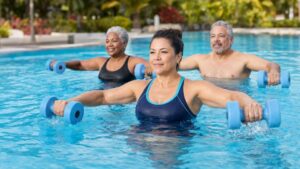
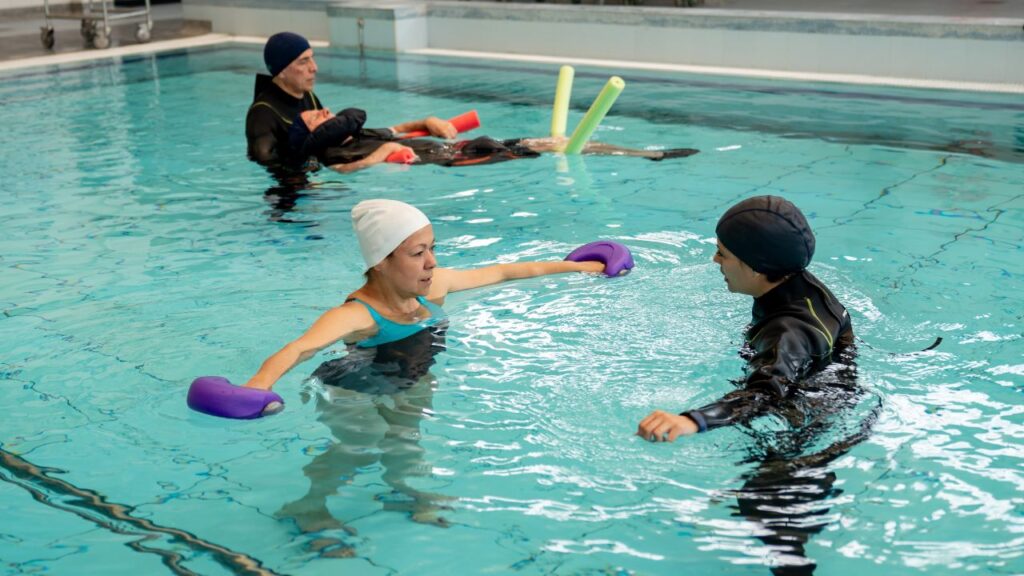
Resistance paddles, gloves, and other tools can change how much water must be moved during an exercise.
That does not mean everyone needs equipment to begin.
The water itself provides resistance.
Equipment can later be used strategically to change the challenge, depending on the exercise, the individual, and the purpose of the workout.
The first goal should be learning to control the movement.
Then resistance tools can become part of progression.
Related Reads:
Top Water Weights for Pool & Resistance Workouts (2026)
Control Matters More Than Simply Moving Fast
A strong aqua fitness workout is not about moving as quickly as possible through every exercise.
Control matters.
Consider a chest fly movement.
Instead of rapidly swinging the arms open and closed, think about:
- Maintaining posture.
- Opening the arms with control.
- Creating resistance against the water by cupping the fingers or holding resistance tools.
- Bringing the arms together intentionally.
- Keeping the core engaged.
- Maintaining a stable position.
The quality of the movement changes the exercise.
Harvard Health notes that water resistance can slow movements that might otherwise become quick or jerky on land, encouraging smoother movement patterns.
This is one of the things I love about teaching in the water.
There is always another layer to explore.
An exercise does not have to become complicated to become more intentional.
Sometimes the progression comes from better control.
Related Reads:
How Water Exercises Improve Stability, Coordination & Everyday Movement
Aqua Fitness Can Train the Upper Body
It is easy to think of the pool primarily as a place for leg exercises.
But the water can also be used for upper-body resistance work.
Exercises may include:
- Arm presses
- Chest fly movements
- Resistance rolls
- Bicep curl patterns
- Cross-body arm sweeps
- Controlled rotations
- Push-and-pull combinations
The hands, forearms, and arms interact with the water throughout these movements.
Changing the direction, speed, range of motion, and equipment can change how the movement feels.
For example, in the Legendary Swimmers Exercise Catalog, one exercise can have different variations based on experience level.
A Basic variation may focus on learning the movement with control.
An Intermediate variation may change the rhythm, speed, or movement pattern.
An Advanced variation may add a more challenging combination or endurance element.
Progression does not always mean picking up a heavier object.
In the water, progression can take many forms.
The Lower Body Works Against Resistance Too
The same principle applies to the lower body.
When you perform:
- Knee lifts
- Leg raises
- Forward kicks
- Backward kicks
- Side kicks
- Aqua jacks
- Lunges
- Squats
- Circle kicks
the legs must move through the water.
The water creates resistance during the movement, while buoyancy reduces the impact associated with many land-based movements.
Mayo Clinic explains that aquatic exercise reduces pressure on bones, joints, and muscles while providing natural resistance.
This combination helps explain why the pool can be used as a place for challenging exercise while still offering a lower-impact environment.
Low impact does not have to mean low effort.
That distinction is important.
An aqua fitness workout can feel challenging without relying on repeated pounding against a hard surface.
Your Core Is Working More Than You May Realize
Core work in the water does not only mean doing a traditional crunch.
Your core helps stabilize the body during many standing aquatic movements.
Imagine performing strong arm movements while trying to maintain an upright position.
Or raising one leg while staying balanced.
Or rotating the upper body while controlling the hips.
Or moving through turbulent water created by your own movement and the movement of others.
All of these situations can require stabilization and body control.
A Mayo Clinic Press article notes that even walking in water with good posture engages the abdominal muscles, while other upper- and lower-body strength movements can also be performed in the pool.
This is why posture is so important during aqua fitness.
The goal is not simply to complete the arm or leg movement.
The entire body participates.
Related Reads:
Why Water Exercises Challenge Your Core Differently
Why Water Exercise Is Considered Low Impact
The strength challenge of water is only one part of the story.
Water also provides buoyancy.
Buoyancy helps support the body, which can reduce the impact experienced by the joints during movement.
Harvard Health explains that the body’s buoyancy in water means the joints experience less impact, making water exercise an attractive environment for people looking for joint-friendly movement.
The CDC also notes that water-based exercise offers physical and mental health benefits and may be beneficial for people living with conditions including arthritis, diabetes, and heart disease.
This is why I believe the phrase low impact should never be confused with ineffective.
You can reduce impact while still creating a purposeful workout.
The two ideas are not opposites.
Related Reads:
Protect Your Joints While Building Strength in the Water
Can You Build Strength Without Heavy Weights?
Strength training requires the muscles to work against resistance.
In aqua fitness, part of that resistance can come from the water itself.
That means a pool workout can challenge the muscles without requiring a traditional rack of heavy weights.
Mayo Clinic states directly that the natural resistance provided by water can help strengthen muscles.
That said, it is important to be realistic.
Different training methods serve different purposes.
Aqua fitness does not have to be presented as a replacement for every form of land-based strength training.
Instead, it can be understood as another valuable way to use resistance.
For someone looking for:
- Low-impact movement
- Muscular endurance work
- Full-body exercise
- Joint-friendly conditioning
- Water-based strength training
- A complement to swimming
- A way to exercise in their own pool
aqua fitness can offer a highly versatile training environment.
How to Make Water Exercises More Challenging
Once you understand the movement, there are several ways a water exercise can progress.
1-Increase movement speed appropriately
A faster movement can increase the resistance you feel from the water.
2-Increase the working surface area
Hand position and appropriate aquatic equipment can change the amount of water you are pushing or pulling.
3-Increase movement duration
Performing an exercise for longer can challenge muscular endurance.
4-Add controlled pulses or patterns
A movement can be modified with smaller controlled repetitions, rhythm changes, or carefully structured combinations.
5-Reduce unnecessary rest
Depending on fitness level and workout design, transitions can become more continuous.
Combine upper- and lower-body movement
For example, an arm pattern can be paired with knee lifts, kicks, or another lower-body movement.
The goal is progression with purpose.
Not complexity for the sake of complexity.
Why Guided Aqua Fitness Workouts Matter
Once people understand that water provides resistance, the next question is usually:
What should I actually do in the pool?
That is where workout structure becomes important.
A complete aqua fitness session can intentionally move through different phases such as:
- Warm-up
- Upper-body resistance work
- Lower-body strength work
- Cardiovascular intervals
- Core training
- Full-body combinations
- Cooldown and mobility
The exercises are selected and organized with a purpose.
That is very different from entering the pool and randomly performing movements.
Guidance removes some of the guesswork.
You can focus on following the workout, learning the exercises, and understanding how your body responds.
Experience Water Resistance for Yourself
You can read about water resistance.
But the easiest way to understand it is to feel it.
That is why we created the free 15-minute Aqua Fitness Workout.
It gives you an opportunity to experience how simple movements change when you perform them intentionally in the water.
You do not need to plan the session yourself.
Get into the pool.
Press play.
And follow along.
Try the Free 15-Minute Aqua Fitness Workout
Ready for More Structured Water Training?
Once you understand how to use water resistance, there is so much more you can do with your pool.
Inside the Legendary Aqua Fitness Studio, guided workouts are designed to help you use the water intentionally through structured strength, cardio, core, and full-body movement.
The goal is simple:
Help you stop wondering what to do in the pool and start using it as a real training space.
Frequently Asked Questions
1. Does water resistance help build strength?
Yes. Moving through water creates resistance that the muscles must work against. Mayo Clinic explains that water provides natural resistance that can help strengthen muscles.
How challenging an exercise feels can depend on factors including movement technique, speed, duration, direction, surface area, and the use of appropriate aquatic equipment.
2. Can aqua fitness replace lifting weights?
Aqua fitness and traditional weight training are different forms of resistance exercise and may serve different goals.
Water exercise can challenge muscular strength and endurance, while traditional progressive resistance training may be more appropriate for other specific training goals.
Aqua fitness can be particularly valuable for people seeking low-impact exercise, muscular endurance, cardiovascular activity, joint-friendly movement, or a water-based complement to other forms of training. Mayo Clinic Health System states that properly performed aquatic workouts can support aerobic fitness, muscular strength and endurance, flexibility, and balance.
3. Why does moving faster feel harder in the water?
Moving more forcefully through the water changes the resistance you experience.
You can feel this yourself by slowly sweeping your hand through the pool and then repeating the motion more quickly.
This is one reason movement speed can be used strategically to change the intensity of aqua fitness exercises.
4. Do I need aquatic dumbbells or resistance equipment?
No. Water already provides natural resistance, so many exercises can be performed without equipment.
Aquatic equipment can later be added strategically to change the challenge of certain exercises, but beginners can first focus on posture, movement control, range of motion, and learning how to push and pull against the water.
5. Is aqua fitness only for beginners?
No.
Water exercise can be adapted by changing the movement, speed, duration, combinations, equipment, and workout structure.
That is why here in legendaryswimmers we provide Basic, Intermediate, and Advanced variations.
The water is the same.
How you use it can change.
6. Can water exercise work the entire body?
Yes. A well-structured water workout can include exercises for the upper body, lower body, core, and cardiovascular system.
Harvard Health notes that because water provides natural resistance, pool movements can provide both aerobic and muscle-strengthening benefits.
7. Is low-impact exercise still challenging?
It can be.
Low impact describes the reduced impact or loading involved in the movement environment; it does not necessarily describe how easy the workout feels.
Water’s buoyancy helps reduce impact on the joints, while resistance can still challenge the muscles and cardiovascular system.
Conclusion
You do not need to look at your pool and see only a place to swim or relax.
The water itself can become part of your training.
Every push.
Every pull.
Every kick.
Every change of direction.
Every controlled movement.
The water responds.
That resistance can help challenge the muscles, build muscular endurance, and create full-body workouts without relying solely on heavy weights.
But the true power of aqua fitness comes from learning how to use that resistance intentionally.
Movement speed matters.
Surface area matters.
Control matters.
Posture matters.
Workout structure matters.
And progression matters.
The pool is not just the location of the workout.
The water is part of the workout.
Start by feeling the resistance.
Learn to move with control.
Then discover just how much your pool can do.
Ready to experience it? Try the free 15-minute Aqua Fitness Workout and feel the difference water resistance can make.
References:
Mayo Clinic — Aquatic Exercises
Mayo Clinic explains that aquatic exercise is low impact and that the natural resistance of water can help strengthen muscles.
https://www.mayoclinic.org/healthy-lifestyle/fitness/in-depth/aquatic-exercise/art-20546802
CDC — Swimming and Your Health
The CDC discusses physical and mental health benefits associated with water-based exercise, including potential benefits for people with certain chronic conditions.
https://www.cdc.gov/healthy-swimming/about/index.html
Harvard Health — Advantages of Water-Based Exercise
Harvard Health discusses buoyancy, reduced joint impact, and how resistance from the water affects movement during aquatic exercise.
https://www.health.harvard.edu/healthbeat/advantages-of-water-based-exercise
Harvard Health — Basic Types of Water-Based Exercise
Harvard Health explains how the natural resistance of water means aquatic exercise can combine cardiovascular activity with muscular work.
https://www.health.harvard.edu/healthbeat/basic-types-of-water-based-exercise
Harvard Health — What Makes Water Workouts So Worthwhile?
Harvard Health discusses swimming and water exercise as forms of cardiovascular and muscular activity.
https://www.health.harvard.edu/heart-health/what-makes-water-workouts-so-worthwhile
Mayo Clinic Health System — Aquatic Exercise: Gentle on Your Bones, Joints and Muscles
Mayo Clinic Health System discusses aquatic exercise in relation to aerobic fitness, muscular strength and endurance, flexibility, and balance.
Mayo Clinic Press — Exercising When You Have Osteoporosis
Mayo Clinic Press discusses the resistance created when pushing against water and provides examples of strength-oriented movements performed in the pool.
https://mcpress.mayoclinic.org/healthy-aging/exercising-when-you-have-osteoporosis/
Arthritis Foundation — In the Swim: Aquatic Exercise for Arthritis
The Arthritis Foundation discusses evidence related to aquatic exercise, joint function, discomfort, and quality of life for people with osteoarthritis.