When you begin water aerobics, even simple movements can feel unfamiliar. The water changes your balance, slows your movements, and provides resistance from multiple directions.
With consistent practice, those movements begin to feel more natural. You may notice that you can maintain better posture, exercise for longer, coordinate your arms and legs more easily, and recover more quickly between movements.
That is the right time to consider progressing your workout.
Progression does not mean rushing into the hardest exercises available. It means gradually changing your routine as your strength, endurance, coordination, and confidence improve.
The Physical Activity Guidelines for Americans recommend beginning with lower-intensity activity and gradually increasing how often and how long you exercise. That same patient approach applies in the pool.
Related Reading: The Science Behind Water Resistance Training: Why It Works
What Does Progression Mean in Water Aerobics?
Exercise progression is the process of making a workout gradually more challenging as your body adapts.
In water aerobics, you can progress by changing:
- Exercise duration
- Number of repetitions
- Range of motion
- Movement speed
- Water depth
- Direction of movement
- Balance demands
- Arm and leg coordination
- Equipment or resistance
- Work and recovery intervals
You do not need to change all these factors simultaneously. Adjusting one variable at a time makes it easier to determine how your body responds.
For example, you could progress from 20 seconds of water walking to 30 seconds before attempting to jog. You could also improve a squat by increasing its controlled range of motion before adding a jump.
Why Gradual Progression Matters
Starting with movements appropriate for your current level gives you time to learn proper form and understand how your body responds to water resistance.
The Mayo Clinic recommends beginning at a light intensity when you are new to exercise and building gradually toward moderate or vigorous activity. Increasing too quickly can contribute to soreness, injury, and burnout.
Gradual progression can help you:
- Develop better movement control
- Improve balance and coordination
- Build muscular endurance
- Increase cardiovascular fitness
- Learn how to use aquatic equipment properly
- Recognize the difference between effort and pain
- Create a routine you can maintain consistently
Progress is not measured only by speed or intensity. Better posture, improved control, and increased confidence are meaningful improvements.
Related Reading: Why Water Exercise Feels Easier Than Land Exercise—But Still Builds Strength
Understanding Basic, Intermediate, and Advanced Levels
Exercise levels are tools for choosing appropriate movements. They are not labels that permanently define your ability.
You may feel comfortable performing an intermediate upper-body exercise while preferring a basic variation of a balance exercise. You may also move between levels depending on your energy, recovery, or health on a particular day.
Basic-Level Water Aerobics
Basic movements focus on:
- Learning proper posture
- Becoming comfortable with water resistance
- Maintaining contact with the pool floor
- Using the pool wall when necessary
- Performing one movement pattern at a time
- Developing balance and coordination
- Exercising for shorter intervals
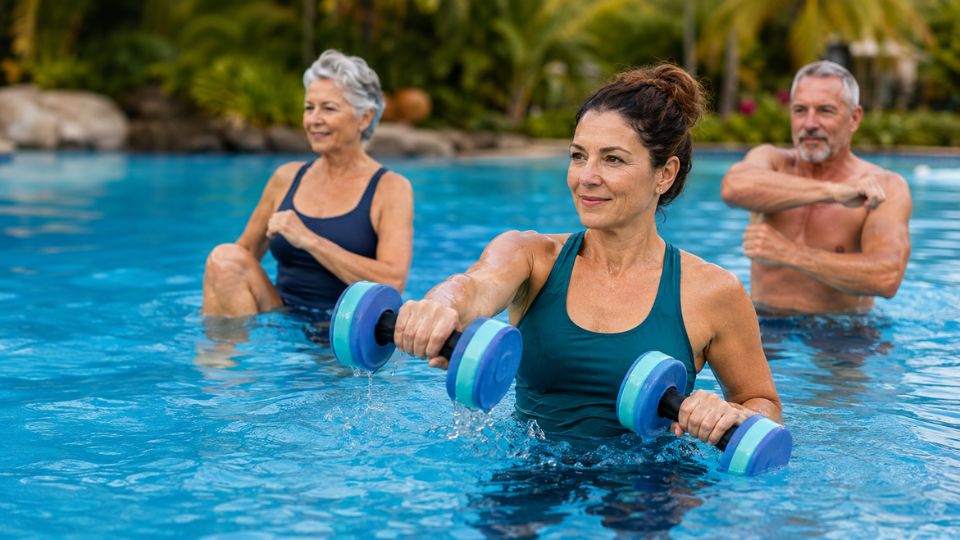
Common basic exercises include water walking, step-touch movements, controlled knee raises, partial squats, and gentle arm sweeps.
Intermediate-Level Water Aerobics
Intermediate movements may include:
- Longer exercise intervals
- Larger controlled movements
- Coordinated arm and leg patterns
- Reduced dependence on the pool wall
- Moderate changes in direction or tempo
- More continuous movement
- Introductory aquatic equipment
At this level, you may begin combining exercises or alternating strength-focused movements with cardiovascular intervals.
Advanced-Level Water Aerobics
Advanced movements may include:
- Faster directional changes
- More complex coordination
- Suspended or deep-water variations
- Longer work intervals
- Shorter recovery intervals
- Additional water resistance
- Controlled power movements
- Multiple movement patterns combined together
Advanced does not mean uncontrolled. Proper alignment and purposeful movement remain essential.
Related Reading: Low-Impact Water Aerobics: Boost Fitness With Aquatic Exercises
That is the right time to consider progressing your workout.
Seven Ways to Progress a Water Aerobics Workout
1. Increase the Duration
One of the simplest ways to progress is to perform an exercise for slightly longer.
For example:
- Basic: Water walk for 20 seconds
- Intermediate: Water walk for 40 seconds
- Advanced: Jog or power walk for 45–60 seconds
Increase duration gradually rather than doubling your workout immediately.
The National Institute on Aging recommends building physical activity gradually over time. Short periods of movement still count, particularly when you are establishing a new routine.
2. Increase Your Range of Motion
Range of motion describes how far a joint moves during an exercise.
A smaller movement is often easier to control. As mobility, balance, and confidence improve, you may gradually make the movement larger.
For example:
- Basic: Lift your knee slightly
- Intermediate: Lift your knee toward hip level
- Advanced: Combine the knee raise with a controlled opposite-arm pull
A larger range is not always better. Use the largest range you can control comfortably without forcing the joint.
3. Add Arm and Leg Coordination
Performing one movement at a time allows you to focus on technique. Combining arm and leg movements increases the coordination and cardiovascular demands.
A step-touch progression could look like this:
- Basic: Step from side to side
- Intermediate: Add controlled arm sweeps
- Advanced: Increase the travel distance and change arm direction
If your posture or timing begins to break down, return to the previous variation.
Related Reading: How Water Exercises Improve Stability, Coordination & Everyday Movement
4. Change the Speed Carefully
Moving faster through water can increase the challenge because the water resists the movement.
However, speed is useful only while you remain in control.
Begin by performing the movement slowly enough to feel the resistance. Once you can maintain proper alignment, increase the tempo slightly.
Avoid using momentum to throw your arms or legs through the water. A controlled movement can sometimes be more demanding than a hurried one.
5. Increase the Surface Area
A larger surface area must push more water, creating additional resistance.
You can change the surface area by:
- Opening your hands instead of slicing through the water
- Using resistance gloves
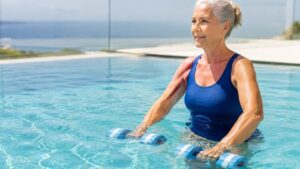
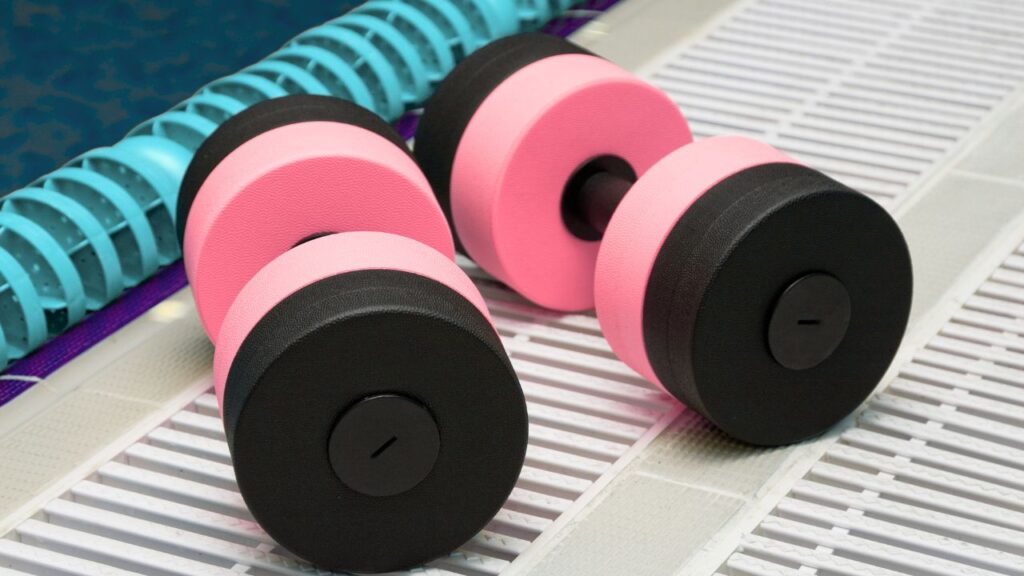
- Holding aquatic dumbbells
- Pressing a kickboard through the water
- Extending an arm or leg farther from the body
The Mayo Clinic’s aquatic-exercise guide notes that hand webs and other resistance devices can increase resistance as the arms move through the water.
Equipment should be added after you can control the exercise without it.
Related Reading: Best Water Workout Equipment for a Stronger Pool Workout
6. Change Your Base of Support
Your base of support affects balance.
A wide stance usually provides more stability. A narrower stance, staggered position, or single-leg movement requires additional control.
A balance progression could include:
- Basic: Stand with your feet shoulder-width apart
- Intermediate: Bring your feet closer together
- Advanced: Shift onto one leg while performing a controlled movement
Use the pool wall whenever necessary. Balance work should challenge your stability without placing you in an unsafe position.
7. Adjust Work and Recovery Intervals
Intervals alternate periods of work with periods of easier movement or rest.
A gradual interval progression might look like:
- Basic: 20 seconds of movement and 40 seconds of recovery
- Intermediate: 30 seconds of movement and 30 seconds of recovery
- Advanced: 40 seconds of movement and 20 seconds of recovery
Recovery can include gentle water walking rather than standing still.
Do not shorten recovery until you can complete the work interval with proper form and recover comfortably.
Related Reading: 30-Minute Pool HIIT Workout for Strength, Fat Loss & Endurance
Exercise Progressions From Basic to Advanced
Water Walking Progression
Basic: Walk forward slowly in waist- or chest-deep water. Keep your back straight and allow your arms to swing naturally.
Intermediate: Increase your pace and add backward or sideways walking.
Advanced: Alternate water jogging with power walking, or hold a kickboard vertically to increase resistance.
The Mayo Clinic identifies water walking as an accessible way to begin aquatic exercise and deep-water jogging as a more intense option.
Hydro Squat Progression
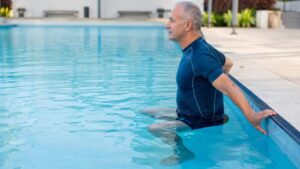
Basic: Perform a partial squat while holding the pool wall.
Intermediate: Increase the range slightly and release the wall when you can maintain balance.
Advanced: Add a controlled upward lift or low-impact power movement, landing with bent knees.
Keep your knees aligned with your feet throughout each variation.
Hydro Knee-Raise Progression
Basic: Alternate slow knee raises while holding the wall.
Intermediate: Release the wall and add opposite-arm movements.
Advanced: Increase the tempo or combine two knee raises with a short water-jogging interval.
Keep your torso upright instead of leaning backward to lift the knee higher.
Aqua Jack Progression
Basic: Step one foot outward at a time while raising your arms.
Intermediate: Perform a small jumping jack with both feet moving together.
Advanced: Increase the movement range, add a power variation, or perform suspended jacks using appropriate flotation equipment.
Hydro Lunge Progression
Basic: Use a small forward step and hold the pool wall.
Intermediate: Increase the step length and alternate legs continuously.
Advanced: Add coordinated arm presses or alternate between forward and side lunges.
Avoid forcing your knees into a deeper bend than you can comfortably control.
Hydro Kick Progression
Basic: Perform small forward kicks while holding the wall.
Intermediate: Alternate forward, side, and backward kicks.
Advanced: Combine different kick directions into a continuous sequence while maintaining balance and posture.
Arm-Sweep Progression
Basic: Move your arms slowly forward and backward with your elbows slightly bent.
Intermediate: Open your hands to increase the surface area and change directions.
Advanced: Add resistance gloves or aquatic dumbbells after you can control the full movement.
Related Reading: Water Aerobics Exercises for Your Upper Body: 10 Effective Moves
A Three-Level Water Aerobics Progression Plan
The following example shows how a simple group of movements can be adjusted for different levels.
Basic Routine
Complete each movement for approximately 20–30 seconds:
- Water walking
- Step-touch
- Controlled knee raises
- Partial Hydro Squats
- Forward arm sweeps
- Low-impact Aqua Jacks
- Gentle water walking for recovery
Focus on posture, breathing, and learning each exercise.
Intermediate Routine
Complete each movement for approximately 30–45 seconds:
- Power walking
- Step-touch with arm sweeps
- Knee raises with opposite-arm pulls
- Full comfortable Hydro Squats
- Alternating forward and backward kicks
- Aqua Jacks
- Moderate water jogging for recovery
Focus on smoother transitions and continuous movement.
Advanced Routine
Complete each movement for approximately 40–60 seconds:
- Water jogging
- Traveling step-touch with changing arm patterns
- Fast controlled knee raises
- Hydro Squats with an optional upward lift
- Multi-directional kicks
- Power Aqua Jacks
- Short recovery interval
Advanced participants can also explore deep-water variations with a properly fitted flotation belt and appropriate supervision.
How Do You Know When You Are Ready to Progress?
Consider progressing when you can:
- Complete the current exercise with consistent form
- Maintain comfortable breathing
- Control both directions of the movement
- Finish the interval without losing your posture
- Recover normally before the next exercise
- Perform the movement without pain
- Repeat the workout consistently
- Finish feeling challenged but not overwhelmed
You do not have to progress simply because a certain amount of time has passed. Some exercises take longer to learn than others.
Signs That You May Be Progressing Too Quickly
Return to an easier variation if you notice:
- Your posture repeatedly breaking down
- Difficulty controlling your arms or legs
- Holding your breath
- Depending on momentum
- Unusual dizziness or shortness of breath
- Sharp or increasing pain
- Difficulty recovering between intervals
- Flotation equipment shifting because of poor body alignment
Feeling your muscles work is different from experiencing pain. Stop an exercise that causes sharp, sudden, or worsening discomfort.
How Often Should You Change Your Water Workout?
There is no required schedule for moving to a harder level.
Instead of changing your routine every week, allow enough time to learn the movements and notice how your body responds. You might increase one interval, add one coordinated arm movement, or introduce one new exercise.
Consistency matters more than creating a complicated routine. Updated guidance from the American College of Sports Medicine emphasizes that regular participation is more important for most people than chasing a “perfect” or overly complex training plan.
Equipment Is Not the Only Way to Progress
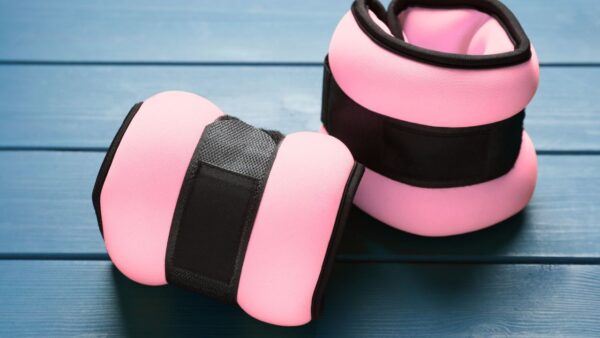
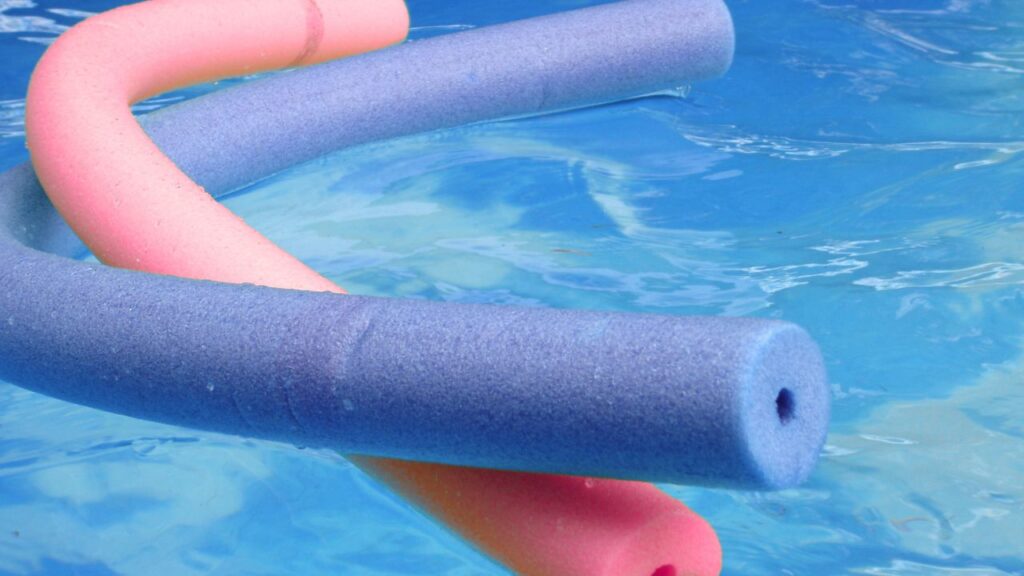
Aquatic dumbbells, resistance gloves, cuffs, kickboards, and noodles can make certain exercises more challenging. However, equipment is only one progression method.
Before adding equipment, consider whether you could first improve:
- Posture
- Range of motion
- Movement control
- Exercise duration
- Coordination
- Recovery
- Consistency
Adding more resistance before mastering the movement may make it harder to maintain good technique.
Related Reading: Protect Your Joints While Building Strength in the Water
Frequently Asked Questions
How do I make water aerobics more challenging?
You can gradually increase the duration, range of motion, speed, coordination, surface area, resistance, or balance demands. Change one factor at a time and maintain proper control.
How long should beginners exercise in the pool?
The appropriate duration depends on your health, fitness level, exercise intensity, and comfort in the water. Beginners can start with short sessions and gradually add time. Even brief periods of physical activity can be beneficial.
Do I need equipment to reach an advanced level?
No. You can create challenging workouts using water resistance alone. Equipment is optional and should be added only when you can control the movement safely.
Is moving faster always a progression?
No. Faster movement is helpful only if you maintain proper alignment and control. A larger, slower movement can sometimes create more muscular effort than a rushed movement.
When should I move from Basic to Intermediate?
Consider moving forward when you can perform the Basic variation consistently, maintain your posture and breathing, and finish without pain or excessive fatigue.
Can I perform Basic and Advanced exercises in the same workout?
Yes. Exercise levels can be mixed. Choose the variation that fits each movement and how you feel that day.
What should I do if an exercise feels uncomfortable?
Reduce the range of motion, slow the movement, use the pool wall, or return to an easier variation. Stop if the movement causes sharp or worsening pain.
Final Thoughts
Progress in water aerobics is not about reaching the Advanced level as quickly as possible.
It is about gradually improving your strength, endurance, coordination, and confidence while maintaining control.
Begin with movements you can perform comfortably. Develop proper form, add time gradually, and change one challenge at a time. Some days you may choose an advanced variation, while on other days a basic version may be the better choice.
Every level can provide a meaningful workout when the exercises are performed with purpose and consistency.
References