
Stronger in the Water. Stronger in Life.
Best Swimming Stroke for Abs | Expert Tips

Swimming offers one of the most comprehensive full-body workouts available, with particular benefits for developing the abdominal muscles. Not only does swimming engage your core continuously for stability, but certain strokes and techniques can specifically target the abdominal region, helping you develop strength, endurance, and definition in this area. This guide, backed by expert insights and research, explores the most effective swimming stroke and techniques for developing your abs.
Why Swimming Is Effective for Abdominal Development
Before diving into specific strokes, it’s important to understand why swimming is particularly effective for core development. Swimming naturally engages the core muscles as they work to stabilize the body against the resistance of water, creating a constant challenge to the abdominal muscles throughout the entire workout.
Research published in the Journal of Sports Sciences found that competitive swimmers have significantly greater core endurance compared to athletes in many land-based sports, with the constant engagement of the transverse abdominis, obliques, and rectus abdominis contributing to their athletic performance.
The water environment provides unique advantages for abdominal training:
- Constant resistance: Water provides approximately 12-14 times more resistance than air, requiring continuous core engagement for stability.
- Reduced impact: Unlike high-impact core exercises on land, swimming eliminates stress on the spine while still challenging the muscles.
- Three-dimensional movement: Swimming engages the core from multiple angles and planes of motion, creating comprehensive development.
- Natural progression: As swimming technique improves, core engagement naturally intensifies without requiring additional equipment.
Ranking the Best Swimming Stroke for Abs
Let’s explore the most effective swimming stroke for abdominal development, ranked by their core engagement potential:
1. Butterfly Stroke: The Ultimate Ab Sculptor
The butterfly stroke stands as the undisputed champion for abdominal engagement among all swimming styles. A study published in the European Journal of Applied Physiology found that butterfly swimmers exhibited significantly greater activation of both the rectus abdominis and oblique muscles compared to other stroke specialists.
Why It’s Effective for Abs:
- The dolphin kick motion requires powerful, wave-like undulations that originate from the core
- The simultaneous arm recovery demands exceptional core stability
- The constant up-and-down body position challenges the abs throughout the stroke cycle
According to research the butterfly stroke’s dolphin kick creates a continuous compression and extension of the core musculature, similar to performing repeated crunches but with the added benefit of water resistance through multiple planes of motion.
Research using electromyography (EMG) shows that butterfly swimming activates approximately 80% of maximum voluntary contraction in the rectus abdominis during the propulsive phase—significantly higher than traditional abdominal exercises like crunches (around 60%).
Muscles Targeted:
- Rectus abdominis (the “six-pack” muscles)
- Internal and external obliques
- Transverse abdominis
- Lower back muscles (erector spinae)
Butterfly Technique Tips for Maximum Ab Engagement:
- Focus on initiating the body dolphin movement from the core rather than just the legs
- Maintain a tight midsection throughout the stroke cycle
- Emphasize a powerful hip drive that originates from the abdominals
- Keep your core engaged even during the recovery phase
2. Freestyle with Rotational Emphasis: The Sustainable Ab Sculptor
While butterfly tops the list for intensity, freestyle (front crawl) with proper rotational emphasis provides an excellent balance of abdominal engagement and workout sustainability.
Why It’s Effective for Abs:
- The rotational component directly engages the oblique muscles
- The alternating arm pattern requires constant core stabilization
- The continual kick pattern maintains lower abdominal activation
Proper freestyle technique requires the body to rotate along its longitudinal axis, which directly engages the oblique muscles with each stroke cycle, creating a natural rotational challenge to the core.
Muscles Targeted:
- External and internal obliques (primary)
- Transverse abdominis
- Rectus abdominis
- Hip flexors
Freestyle Technique Tips for Maximum Ab Engagement
- Emphasize body rotation from the core rather than just the shoulders
- Maintain a tight midsection while rotating
- Focus on initiating rotation from the hips rather than the shoulders
- Keep the core engaged during the breathing pattern
If you want to further improve your freestyle body rotation, breathing rhythm, and stroke efficiency, explore our complete guide on “How to Swim Freestyle Like a Pro.”
3. Backstroke: The Posture-Enhancing Ab Builder
Backstroke offers unique abdominal benefits, particularly for the deeper core stabilizers and the lower abdominals. Backstroke swimming creates significant activation in the lower portion of the rectus abdominis due to the horizontal body position and the specific kick pattern required.
Why It’s Effective for Abs:
- The supine position requires continuous engagement of the deep core stabilizers
- The flutter kick originates from the lower abdominals
- The arm recovery phase challenges core stability
- The horizontal body position eliminates any possibility of slouching
National Institutes of Health explains: “Backstroke creates a unique challenge to the core musculature because swimmers must maintain a horizontal body position without visual feedback. This requires continuous engagement of the deep core muscles to prevent the hips from sinking.” Maintaining proper body position is one of the most important elements of efficient backstroke technique. If you want to improve your alignment, kick control, and overall stroke mechanics, explore our guide on “Backstroke Technique – Improve Your Backstroke Form Easily.”
Muscles Targeted:
- Lower rectus abdominis
- Transverse abdominis
- Deep core stabilizers
- Hip flexors
4. Breaststroke: The Functional Core Developer
While often considered less intense than other strokes, breaststroke offers specific benefits for developing functional core strength. A study in the International Journal of Sports Medicine found that breaststroke creates significant activation in the rectus abdominis during the recovery phase of the kick.
Why It’s Effective for Abs:
- The glide phase requires sustained core engagement
- The whip kick originates from the core and hip flexors
- The arm recovery phase encourages core stabilization
- The timing elements challenge neuromuscular coordination
Breaststroke’s unique movement pattern creates a distinct core challenge during the glide phase, requiring swimmers to maintain core tension while extending the body, similar to a moving plank position. Developing an efficient whip kick and maintaining proper timing throughout the stroke can significantly improve both propulsion and core engagement.
Muscles Targeted:
- Rectus abdominis
- Hip flexors
- Lower back muscles
- Transverse abdominis
Breaststroke Technique Tips for Maximum Ab Engagement:
- Focus on maintaining a tight core during the glide phase
- Initiate the kick from the core rather than just the legs
- Keep the abdominals engaged during the recovery phase
- Maintain proper body alignment through core stabilization
For a deeper breakdown of kick mechanics and technique improvement, read “Improve Breaststroke Kick Technique: Tips, Drills & Workouts.”
Specialized Swimming Drills for Enhanced Ab Development
Beyond the standard strokes, specific swimming drills can significantly increase abdominal engagement:
1. Vertical Kicking: The Ultimate Core Challenger
Vertical kicking involves maintaining a vertical position in deep water while performing flutter or dolphin kicks to stay afloat.
How to Perform:
- Move to the deep end of the pool
- Position your body vertically with your head above water
- Keep your arms crossed over your chest or extended overhead
- Perform flutter kicks or dolphin kicks to maintain position
- Start with 20-30 second intervals, gradually increasing duration
2. Kickboard Core Series: Targeted Ab Work
Using a kickboard specifically for core development can isolate and intensify abdominal engagement. According to experts specific kickboard drills increased rectus abdominis activation as compared to regular swimming. Kickboards are not only useful for technique work, but can also become an effective low-impact conditioning tool when used strategically.
Effective Kickboard Drills:
- Kickboard Press: Hold the kickboard vertically underwater, pressing it forward while engaging your core
- Kickboard Flutter: Hold the kickboard overhead while performing flutter kicks, focusing on initiating from the core
- Side-Lying Kick: Position yourself on your side holding the kickboard with the bottom arm extended, kick while maintaining core stability
How to Implement:
- Incorporate 4-6 sets of 30-50 meters of each drill
- Focus on quality movement rather than speed
- Maintain continuous core engagement throughout each drill
If you are curious about how kickboard training compares to traditional fitness routines, explore “Replacing Gym Workouts With Kickboard Swimming: Is It Effective?”
3. Streamline Dolphin Kicks: Underwater Core Power
Underwater dolphin kicks performed in a streamlined position create intense abdominal engagement. According Research underwater dolphin kicking created peak core muscle activation similar to traditional Pilates exercises.
How to Perform:
- Push off the wall in a tight streamlined position
- Initiate dolphin kicks from the core, creating a wave-like motion
- Keep arms extended overhead, squeezing your ears
- Focus on powerful, controlled movements
4. Pull Buoy Core Holds: Isolation for Progression
Using a pull buoy between your legs while focusing on core engagement can significantly improve abdominal activation during swimming. A study by National Institutes of Health (NIH) suggests that swimming with a pull buoy while consciously engaging the core increased activation of the transverse abdominis by approximately 25%.
How to Perform:
- Place a pull buoy between your thighs
- Focus on swimming with your upper body only
- Maintain a tight core to prevent your legs from sinking
- Progress by moving the pull buoy lower toward the ankles
Dr. Mullen recommends: “Pull buoy swimming with conscious core engagement creates a similar effect to performing planks while adding the shoulder and upper body movements of swimming.”
Creating an Effective Swimming Workout for Abs
To maximize abdominal development through swimming, consider this progressive 8-week program:
| Category | Phase 1: Foundation (Weeks 1–2) | Phase 2: Development (Weeks 3–5) | Phase 3: Advanced (Weeks 6–8) |
|---|---|---|---|
| Frequency | 3 sessions/week | 3–4 sessions/week | 4 sessions/week |
| Duration | 30 mins/session | 40 mins/session | 45–60 mins/session |
| Focus | Technique + core activation | Intensity + stroke variety | High-intensity + core specialisation |
| Warm-up | 200m freestyle with core focus | 300m alternating freestyle/backstroke | 400m mixed strokes |
| Main Set | 8 × 50m freestyle (focus on rotation, 20s rest) | 6 × 75m (25m butterfly + 25m backstroke + 25m freestyle) | 10 × 50m butterfly (35s rest) |
| Drill Set | 4 × 25m kickboard core work | 4 × 30s vertical kicking | 6 × 45s vertical kicking |
| Core Set / Circuit | – | 4 × 25m streamline dolphin kicks | Alt. 25m dolphin kicks + 25m freestyle with pull buoy holds |
| Cool-down | 100m choice of stroke | 100m breaststroke | 200m choice of stroke |
Conclusion
For the best abdominal results from swimming, combine stroke variety, focused technique, and consistent core engagement. Butterfly and freestyle with rotation are ideal, but incorporating drills like vertical kicking and dolphin kicks enhances effectiveness. Developing strong swimming fundamentals through proper body positioning and stroke mechanics can also improve overall core activation, which is why many swimmers begin with techniques covered in our “Essential Swimming Techniques for Beginners: Complete Guide.”
Train regularly, support your swimming with dryland core work such as the exercises featured in “Top Breaststroke Dryland Workouts to Boost Speed and Power,” and prioritise nutrition for visible results in our “Best Foods for Swimmers: Nutrition Guide for Peak Performance.” Swimmers looking to further improve overall strength and muscular development in the water may also enjoy “Best Swimming Strokes for Muscle Building 2026.”
For more tips and structured swim workouts, visit LegendarySwimmers.com.
References
- European Journal of Applied Physiology
- National Institutes of Health
- International Journal of Sports Medicine
Related: Best Swim Workout to Burn Fat Faster Than Ever Before!
Share:
More Posts
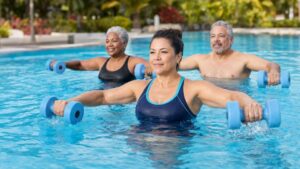
Start Training in the Water
Free Resources
Improve your swimming, build strength, or move with less impact using the water as your training space.
Choose a free resource below to get started.
Recommended Equipment
These are some of the swim training tools and aquatic fitness essentials commonly used to improve technique, build strength, and create a more effective experience in the water.
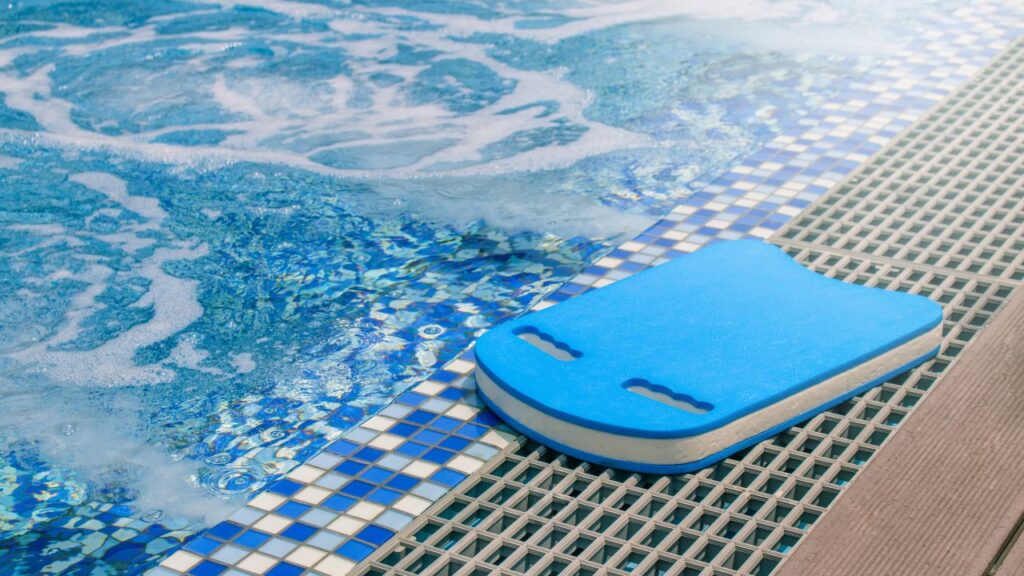
Kickboard Training
Helps improve kicking strength, body position, and lower-body endurance during swim practice.
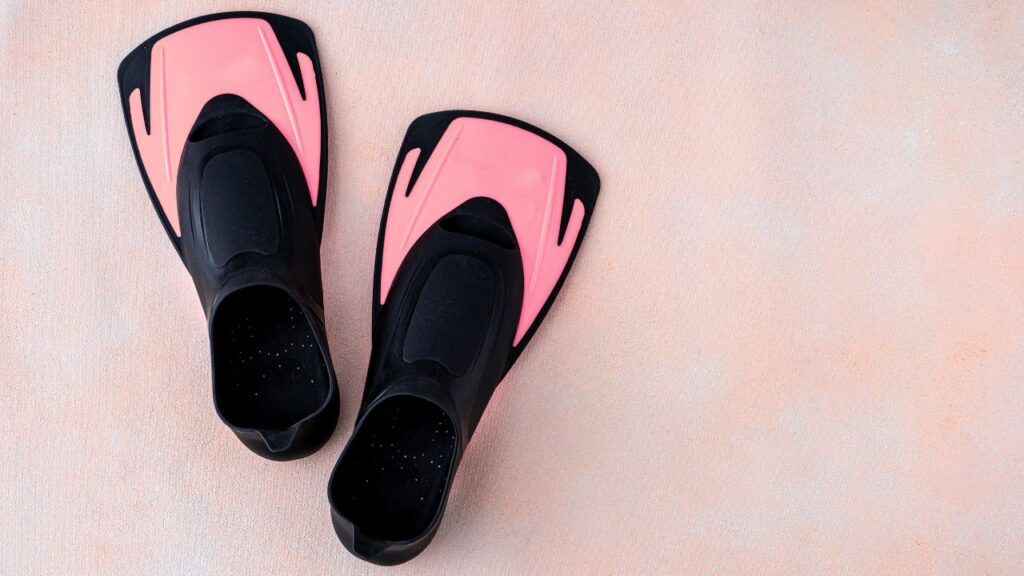
Swim Training Fins
Builds leg power, improves kick technique, and creating smoother movement through the water.
Pull Buoy Float
Supports upper-body focused swim training by helping stabilize the legs during drills and technique work.
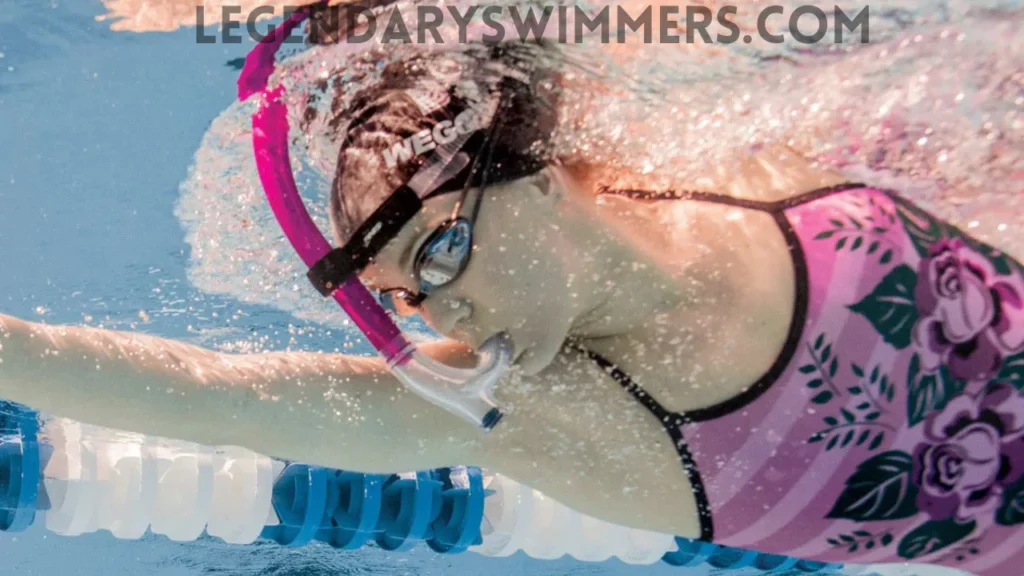
Front-Mount Swim Snorkel
Allows swimmers to focus on body position and stroke technique without turning to breathe.
Swim Goggles
Designed to improve underwater visibility and comfort during training, lap swimming, and aquatic workouts.

Swim Cap
Helps reduce drag, improve comfort, and keep hair more secure during swim training and aquatic workouts.
Waterproof Fitness Tracker
Tracks movement, activity, heart rate, and consistency during swimming, pool walking, and aquatic wellness routines.
Disclosure: Links above are affiliate links, meaning Legendary Swimmers may earn a small commission at no additional cost to you.
Choose How You Prefer to Train in Water
Whether you are here to improve your swimming, build strength, or move with less impact, Legendary Swimmers gives you simple ways to use the water as your training space.
Start with one of our free resources below and choose the path that fits how you want to move in the water.