Exercise Levels
Listen to your body. Adjust with confidence.
These exercise variations are here to support you through real life. Even if you’re following an intermediate or advanced workout, you can always modify a single movement when something feels off.
For example, if your ankle feels sensitive and you want to reduce impact, choose a lower-impact variation for this exercise — without needing to change your entire workout level.
This approach allows you to stay consistent, protect your body, and keep moving forward safely.
Chest Fly
Basic/Level 1
This beginner version of the Chest Fly focuses on controlled upper-body movement using natural water resistance. With arms extended wide and fingers closed to increase drag, the participant sweeps the arms forward in a slow arc before opening them again. The movement strengthens the chest, shoulders, and arms while encouraging proper posture and gentle core engagement.
Stand upright in chest-deep water with feet hip-width apart and knees slightly soft. Extend both arms out to the sides at shoulder height with fingers closed. Slowly sweep the arms forward as if hugging a large beach ball until the palms nearly meet in front of the chest, then open the arms back out to the starting position. Maintain a lifted chest, relaxed shoulders, and steady core throughout the movement.
Best For:
• Beginners learning aquatic resistance training
• Clients focusing on posture and gentle upper-body toning
• Older adults or those with joint sensitivity
• Warm-ups or mobility-focused sessions
This foundational version builds upper-body awareness and chest activation while allowing participants to safely develop strength and coordination in the water.
Intermediate/Level 2
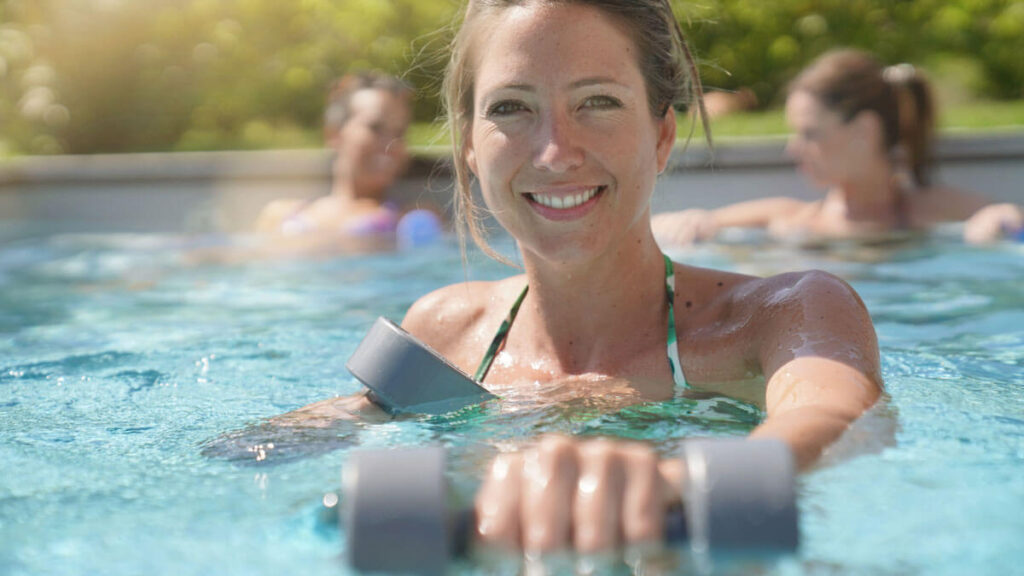
This intermediate version increases resistance by incorporating aquatic dumbbells, creating greater drag throughout the movement. The wide sweeping motion activates the chest, shoulders, and arms while requiring more strength and control to move the dumbbells through the water. The added resistance challenges endurance while maintaining smooth and controlled movement patterns.
Stand upright in chest-deep water with feet grounded and knees slightly bent. Hold an aquatic dumbbell in each hand with arms extended out to the sides at shoulder height. Keep the dumbbells fully submerged as you sweep both arms forward in a controlled arc until the dumbbells nearly touch in front of the chest. Pause briefly before opening the arms back out wide. Maintain strong posture, engaged core, and steady breathing throughout the movement.
Best For:
• Clients progressing beyond bodyweight resistance
• Participants looking to tone chest and arms with joint-friendly resistance
• Upper-body focused aquatic workouts
• Rehab-to-strength transitions using moderate resistance
This version builds muscular endurance and improves upper-body control while introducing additional drag through aquatic equipment.
Advanced/Level 3
This advanced version intensifies the traditional Chest Fly by adding a forward and backward pulse before each full sweeping motion. The pulses increase time under tension and activate the chest and shoulders before the full fly movement. When combined with aquatic dumbbells or resistance gloves, the exercise becomes a powerful upper-body sculpting movement that also demands strong core stability and balance.
Stand tall in chest-deep water with feet hip-width apart and knees slightly soft. Hold aquatic dumbbells fully submerged in front of the chest with elbows slightly bent. Perform a small forward pulse followed by a quick backward pulse before sweeping the arms open wide into a T-position. After the sweep, bring the arms back together in front of the chest with control. Repeat the pulse-pulse-sweep sequence while maintaining upright posture and steady core engagement.
Best For:
• Advanced participants seeking upper-body sculpting
• Athletes or experienced aquatic fitness clients
• Strength-focused upper-body training sessions
• Improving control and coordination under high resistance
This version maximizes chest and shoulder activation while increasing time under tension, creating a powerful yet completely joint-friendly strength exercise.
Safety Notes
Always move within a comfortable range of motion. Stop if you feel pain or discomfort and choose a lower-level variation when needed.